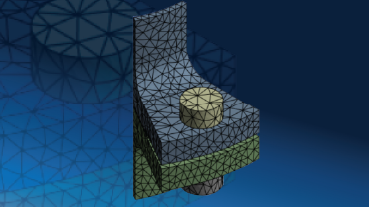
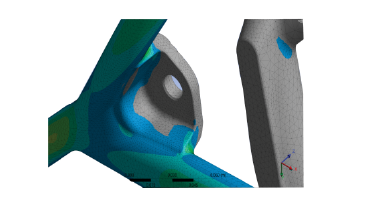
Exploring Advanced Fatigue Life Evaluation Methods Using nCode DesignLife
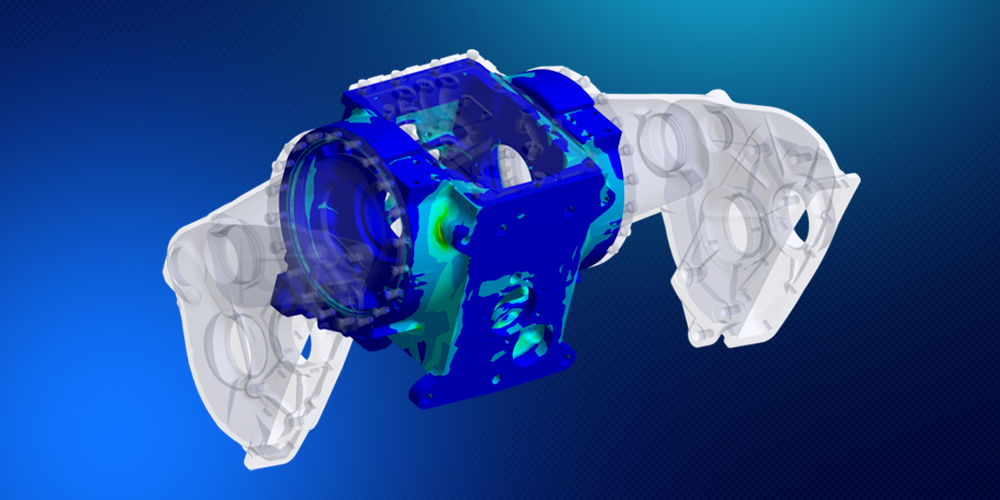
This webinar will provide an overview of advanced fatigue life prediction and evaluation techniques using nCode DesignLife, focusing on understanding…
Register Now
Ansys structural simulation has a powerful pool of solvers used by engineers to analyze and predict the behavior of structures under various loading conditions. It employs advanced finite element analysis (FEA) techniques to simulate how structures respond to different loads, such as mechanical forces, thermal effects, and fluid pressures.

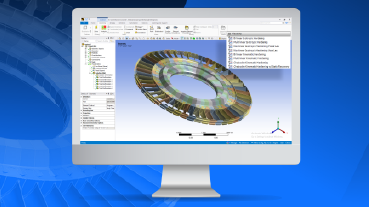
Ansys Mechanical empowers users to address intricate structural engineering challenges and enhance design decision-making processes swiftly. Leveraging the suite's finite element analysis (FEA) solvers, you can tailor and streamline solutions for structural mechanics issues, while also parameterizing them to explore numerous design scenarios. Ansys Mechanical offers a versatile array of analysis tools, spanning from preprocessing to analysis and facilitating integration with additional physics for heightened accuracy. Its user-friendly and adaptable interface ensures engineers of varying proficiency levels can swiftly obtain reliable answers, fostering confidence in their analyses.

Ansys LS-DYNA is the global leader in the field of explicit simulation program and can simulate the response of materials to short duration events like crash, explosion, bird strike, penetration and Impact. Possessing the complex material models, advanced element technology, contact formulations and fast multiphysics solvers, Ansys LS-DYNA can address highly challenging engineering problems.

Ansys Motion is a powerful engineering simulation software designed to analyze the dynamics and kinematics of mechanical systems. It offers comprehensive tools for simulating the motion and behavior of various mechanical components, ranging from simple mechanisms to complex multi-body systems.

Ansys Forming provides a comprehensive solution for simulating metal stamping processes, offering an integrated workflow that covers all stages of die design and analysis within a single platform, ensuring swift solve times. By utilizing Ansys Forming, users can attain peak performance while upholding efficiency and precision, lead

Ansys Sherlock utilizes its physics based solver to transform the reliability analysis for electronic hardware, providing rapid and accurate life predictions across component, board, and system levels in the initial design stages. With Sherlock, designers liberate themselves from the repetitive 'test-fail-fix-repeat' cycle, equipped with the capability to intricately simulate silicon-metal layers, semiconductor packaging, printed circuit boards (PCBs), and assemblies.

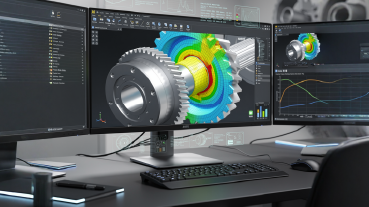
Ansys nCode DesignLife seamlessly integrates with Ansys Mechanical to deliver dependable fatigue life assessments. Leveraging finite element analysis (FEA) results from Ansys Mechanical and Ansys LS-DYNA, it computes damage accumulation due to cyclic loading, providing insights into a product's anticipated lifespan. This enables swift evaluation of diverse materials and alternative geometries for new designs, facilitating optimization tailored to the product's projected usage—well in advance of prototype construction or costly testing.

Ansys Autodyn excels in simulating the response of materials to short-duration, severe mechanical loadings, high pressures, and even extreme conditions such as explosions. It provides advanced solution methods without sacrificing ease of use, allowing for the efficient simulation of complex material responses like large deformations or failures. It is integrated within Ansys Workbench and features its own native user interface, which is renowned for its ease of use, helping users to achieve accurate results with minimal time and effort.

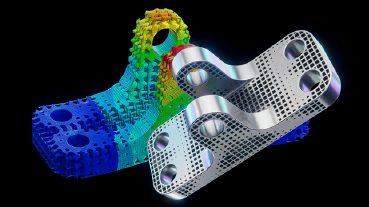
Ansys Additive Suite is a comprehensive solution for the entire additive manufacturing workflow, which includes design for additive manufacturing (DfAM), validation, print design, process simulation, and exploration of materials. It encompasses a range of tools such as Additive Prep, Additive Print, Additive Science, and Workbench Additive, providing critical insights required for a successful additive manufacturing process. This suite helps in avoiding build failure and ensures that parts are designed accurately to specifications. It also includes capabilities for topology and lattice optimization, metal PBF process simulation, distortion compensation, build failure prediction, material analysis, and predictions of melt pool, porosity, and microstructure, among others.

Ansys Sound is a post-processing tool that allows engineers to analyze and optimize their product noise using desired sound quality criteria and listening tests. Innovative time-frequency analysis and processing functions are available for isolating and modifying sound components and assessing the influence of sounds on human perception. Ansys Sound reproduces the 3D sound in-simulator and in-vehicle, including tools to tune Active Sound (ICE) or electric vehicles (EVs).

When working with any material model, it is necessary to determine the appropriate material parameters from experimental data. This process can be quite challenging, especially when dealing with advanced, non-linear material models. To simplify this parameter extraction, Polymer FEM has developed MCalibration, a software application that facilitates the semi-automatic derivation of relevant material parameters directly from experimental results.

The PolyUMod® family offers advanced user-defined material models specifically designed for the finite element modeling of polymers, biomaterials, and various other non-linear materials. This suite also encompasses specialized models tailored for particular material formulations, such as fluoropolymers and ultra-high molecular weight polyethylene (UHMWPE).
Simulate the nonlinear dynamics of solids, fluids, gas, and their interaction. Autodyn includes finite element solvers for computational structural dynamics, and mesh-free particle solvers for high velocities, large deformation, and fragmentation. It also features multi-solver coupling for multi-physics solutions, including coupling between FE, CFD, and SPH, as well as a wide suite of material models that incorporate constitutive response and coupled thermodynamics.
Featuring embedded libraries boasting a vast array of over one million parts, Sherlock swiftly transforms electronic computer-aided design (ECAD) files into computational fluid dynamics (CFD) and finite element analysis (FEA) models. Each meticulously crafted model encompasses precise geometries and material properties, seamlessly translating stress information into validated time-to-failure predictions.
Crashworthiness simulation in LS-DYNA finds application across the automotive industry, including vehicle design, crash testing, regulatory compliance, and safety analysis. Automotive manufacturers use LS-DYNA to assess vehicle crashworthiness, optimize safety features, and meet stringent regulatory requirements for occupant protection.
Drop test and impact simulation in LS-DYNA provide engineers with a valuable tool for assessing the structural integrity and performance of products subjected to dynamic loading conditions. By leveraging advanced numerical techniques and robust material models, organizations can optimize designs, enhance product durability, and minimize the risk of failure due to impact events in various industrial applications.
Simulate heat conduction, convection and radiation across assemblies and simulate the effect of temperature resulted by the various modes of heat transfer on the structure by evaluating thermal stress.
Simulate the behavior of structures for modal analysis, random vibration, seismic vibration and Harmonic vibration.
Ansys Topology Optimization broadens the horizons of design process performance goals. Whether you aim to decrease aircraft weight or enhance the design of a civil structure, Ansys Topology Optimization in Mechanical offers avenues for innovative design with rapidity and effectiveness.
Define composite materials, fabrics and stack-ups and optimize product integrity.
Simulate the life parameters of the structure when it is exposed to repetitive cyclic load.
Simulate the behavior of structures for static or transient loads and understand the load carrying capacity by evaluating stresses & strains.
This webinar will provide an overview of advanced fatigue life prediction and evaluation techniques using nCode DesignLife, focusing on understanding…
Register NowConsumer appliances experience a wide range of mechanical loads throughout their lifecycle, from manufacturing and transportation to installation and…
View DetailsThis webinar will provide an introduction to Ansys Discovery and its capabilities for rapid engineering simulation. The session will focus on Structu…
View DetailsAnsys Mechanical 2026 R1 introduces enhancements designed to streamline structural simulation, improve computational efficiency, and help engineers m…
View DetailsRolling bearings play a critical role in the performance, durability, and reliability of rotating machinery. Accurately representing bearing behaviou…
View DetailsAnsys Structures 2026 R1 đã được ra mắt với nhiều cải tiến nổi bật cho Ansys Mechanical và Ansys LS-DYNA, giúp tối ưu quy trình mô phỏng, nâng cao hi…
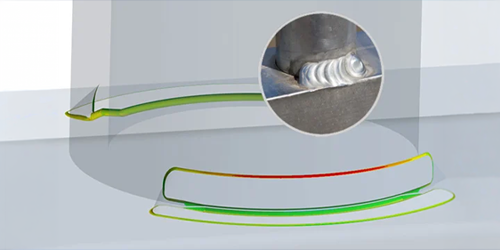
View DetailsWelded joints are critical to the structural integrity of many engineering products, yet assessing their strength and fatigue performance can be comp…
View Detailsร่วมอัปเดตความสามารถล่าสุดของ Ansys Structures 2026 R1 กับผู้เชี่ยวชาญจาก CADFEM ที่จะพาคุณสำรวจฟีเจอร์ใหม่และการพัฒนาที่ช่วยเพิ่มประสิทธิภาพในการวิเ…
View DetailsEngineering teams are under constant pressure to evaluate more design concepts, reduce simulation turnaround time, and accelerate innovation. Ansys S…
View DetailsMetallic components are often subjected to complex loading conditions where demonstrating sufficient strength, durability, and fatigue life is critic…
View DetailsBolted joints are among the most widely used machine elements, yet their verification becomes challenging when multiple bolts, complex geometries, pr…
View DetailsAnsys 2026 R1 menghadirkan berbagai peningkatan pada kemampuan simulasi struktural yang dirancang untuk membantu engineer bekerja lebih cepat, lebih…
View DetailsLaminated composite materials such as fiber reinforced polymers (FRPs) offer exceptional strength-to-weight ratios, making them essential in aerospac…
Read ArticleDi tengah pesatnya perkembangan teknologi rekayasa, adopsi CAE di Indonesia menjadi kunci utama dalam meningkatkan efisiensi dan produktivitas berbag…
Read ArticleModern engineering simulation helps teams test products virtually before they are built, improving safety, performance, and reliability. From washing…
Read ArticleKhám phá cách bộ giải CESE (Conservation Element & Solution Element) trong LS-DYNA mô phỏng sóng nổ di động của thuốc LX-17 trong vỏ hình trụ 3D — nề…
Read ArticleMany structural failures originate at component interfaces. Learn how to use contact nonlinearity in Ansys Mechanical to capture separation, friction…
Read ArticleUnderstand how to apply rotational velocity as inertial body loads in Ansys Mechanical's Static Structural analysis, validate results against Roark's…
Read ArticleDi era industri modern, mayoritas engineer di Indonesia kini beralih ke Finite Element Analysis (FEA) untuk mengvalidasi desain, memprediksi kegagala…
Read ArticleLearn how Ansys Design Life's shell seam weld method evaluates fatigue life at welded joints in a vehicle subframe, identifying critical weld locatio…
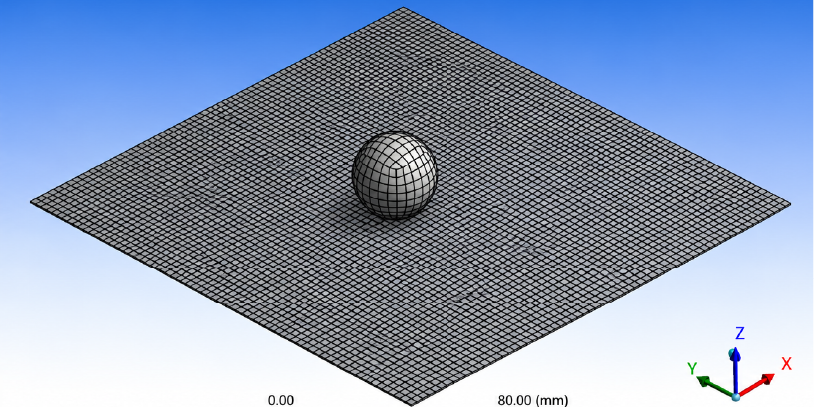
Read ArticleLearn how to implement the Archard wear model in Ansys Mechanical using TB,WEAR APDL commands, configure contact elements, and extract wear depth res…
Read ArticlePart 2 of the ceiling fan simulation series: FSI analysis, gradient-based blade optimisation, aeroacoustic noise prediction, and IS 374 test automati…
Read ArticleLearn how Ansys Fluent helps optimize ceiling fan blade design through airflow simulation, air delivery analysis, torque estimation, and design optim…
Read ArticleIn the rapidly evolving landscape of biomedical engineering, cardiovascular stents play a crucial role in treating artery blockages and restoring blo…
Read ArticleAs engineers, achieving accurate simulation results is paramount to the success of any project. Explore how mesh convergence, local mesh refinement,…
Read ArticleIn the world of structural simulations, material behavior plays a crucial role in predicting how materials respond under different loading conditions…
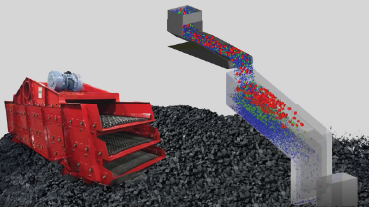
Read ArticleExplore how DEM-FEM coupling—using Ansys Rocky for DEM and Ansys Mechanical for FEM—enhances the design and performance of vibrating screens, a criti…
Read ArticleExplore how local mesh refinement in Ansys Mechanical mitigates stress singularities at sharp corners and notches—capturing stress behaviour precisel…
Read ArticleLearn how Geometry-Based Adaptivity in Ansys Mechanical dynamically refines the mesh along actual geometry boundaries during solving—improving accura…
Read ArticleSee how LS-DYNA’s FSI capabilities enable precise simulation of parachute deployment—from drogue design and structural analysis to fluid modeling, po…
Read ArticleAbhinava Rizel is challenging inadequate motor efficiencies by using Ansys Motor-CAD, Fluent, Maxwell, and Mechanical...
Read Case StudyStatiq used Ansys Fluent, Mechanical, and optiSLang to accelerate off-board EV charger development...
Read Case StudyTaraUAV is redefining unmanned autonomous capabilities through precision engineering and sophisticated materials innovation...
Read Case StudyStructural simulations for turbomachinery application enable engineers to assess factors such as stress distribution, fatigue life, and natural frequencies of blades, shafts, casings, and other structural elements.
Structural simulation of chassis components to evaluate factors such as stress distribution, deformation, and fatigue life. Engineers simulate loading conditions such as static loads, dynamic loads, and road-induced vibrations to assess chassis performance. By optimizing material selection and geometry, engineers can enhance chassis stiffness, strength, and durability.
Analyzing the strength of composite materials used in turbine blades requires a comprehensive approach that considers various factors such as material properties, layup configurations, loading conditions, and failure criteria. Ansys provides advanced simulation tools that are well-suited for conducting composite strength analysis for turbine blades.
Using Ansys Mechanical, engineers can effectively perform topology optimization for machine frames, leading to the design of lightweight and structurally efficient structures that meet or exceed performance requirements. This approach enables the development of innovative and optimized machine frame designs that can improve overall system performance, reduce material usage, and lower manufacturing costs.
Using Ansys Mechanical, engineers can effectively analyze the harmonic vibration behavior of motor systems, identify potential issues such as resonance or excessive vibration, and optimize the design to improve performance, reliability, and efficiency. This approach enables the development of motor systems that meet stringent performance requirements and operate reliably under various operating conditions.
Using Ansys Mechanical, predict the behavior of engine components under the combined effects of thermal gradients and vibrational loading.
Using powerful features of LS-DYNA like material modeling, contact algorithms, element technology, Automotive crash simulation gives you accurate results giving you the confidence on par with the field testing.
Ansys Motion facilitates kinematic analysis of mechanisms, such as linkages, cams, gears, and pulleys. It allows engineers to study the motion characteristics, velocities, and accelerations of individual components within a mechanical system.
Engineers can use Ansys Motion to simulate the motion control of robotic systems, manipulators, and actuators. It helps in designing and tuning control algorithms to achieve desired performance objectives, such as trajectory tracking and stability.
Autodyn helps in design evaluation of safety systems for military, space, energy and nuclear applications by predicting blast/high impact behaviors.
Autodyn predicts the drop & impact scenario to assess the safety of the part under consideration.
End-to-end workflow assisting additive manufactured parts from geometry creation till part validation.
Separate components based on tachiometric information, Create dataset for driving simulator, Assess sound quality.
Original recording, electric and electromagnetic noise.
Isolate based on order analysis, mix each isolated sound source, blade passing frequency, buzz saw noise.
Sound quality evaluation.
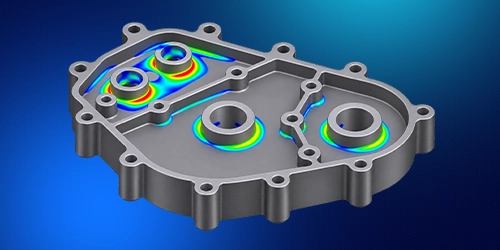
Ansys 3D Design is a suite of tools — including SpaceClaim and Discovery — that lets engineers create, modify, and simulate 3D geometry directly within the Ansys simulation environment, eliminating the need to switch between separate CAD and analysis packages.
Licensed users can download Ansys SpaceClaim and Discovery through the Ansys Customer Portal. Contact CADFEM APAC to obtain a licence or request a free trial for evaluation.
Download the installer from the Ansys Customer Portal, run the setup wizard, and enter your licence server details. Detailed system requirements and step-by-step guides are available in the Ansys Installation Guide included with the download.
Ansys offers free self-paced courses on Ansys Learning Hub, along with official documentation and video tutorials. CADFEM APAC also provides instructor-led training tailored to your industry and workflow.
Use File → Save As to export geometry in formats such as STEP, IGES, ACIS, Parasolid, STL, and more. SpaceClaim also supports direct export to downstream Ansys solvers via Workbench.
Ansys Discovery generates an automatic mesh in real time as you run simulations. For refined control, switch to Refine Mode where you can define mesh sizing, inflation layers, and element types before solving.
Whether you're solving complex engineering challenges, accelerating innovation, or exploring new possibilities with simulation and digital engineering, our team is ready to support you. Backed by deep technical expertise and industry experience, we work closely with organizations to transform ideas into reliable, high-performance solutions. Connect with us to discover how CADFEM can help drive your next breakthrough.
CONTACT US